
It is no wonder that Lucy Calkins refers to conferring as “the heart of the work”. In 2015, when I first heard Lucy Calkins speak in person, she shared a story of a time when she was working with a group of teachers. During this time, she had read a student’s piece of writing with them; it read, “My grandfather was sick. He went to the hospital. He died. He went to God.” She asked the teachers how they would confer with that student. After a bit of time, one of them said that she would just hug the child and tell that child how sorry she was about his grandfather.
It was this story that began a major shift in my understanding of conferring. Each and every writing conference we enter into, we must go into it with listening ears, ready to be responsive and meet our writers where they are. We know within that conference we will be teaching our writer something, but we won’t know exactly what our teaching point will be until we engage in the act of listening first!
For me, this epiphany was deep! It was also freeing. As responsive teachers who know a lot about each of our students as writers, we may go into a conference with some ideas as to what our teaching point will be for that day. But it isn’t until we actually listen to what the child is working on that we can formulate our plan. Approaching a writing conference in this way should not be confused with ‘just winging it’. No. Rather, it requires a great deal of insight into the development of a writer and the direction that you will guide that writer.
Even though each writing conference is unique, each conference should follow a predictable structure.
Structure of a Writing Conference:
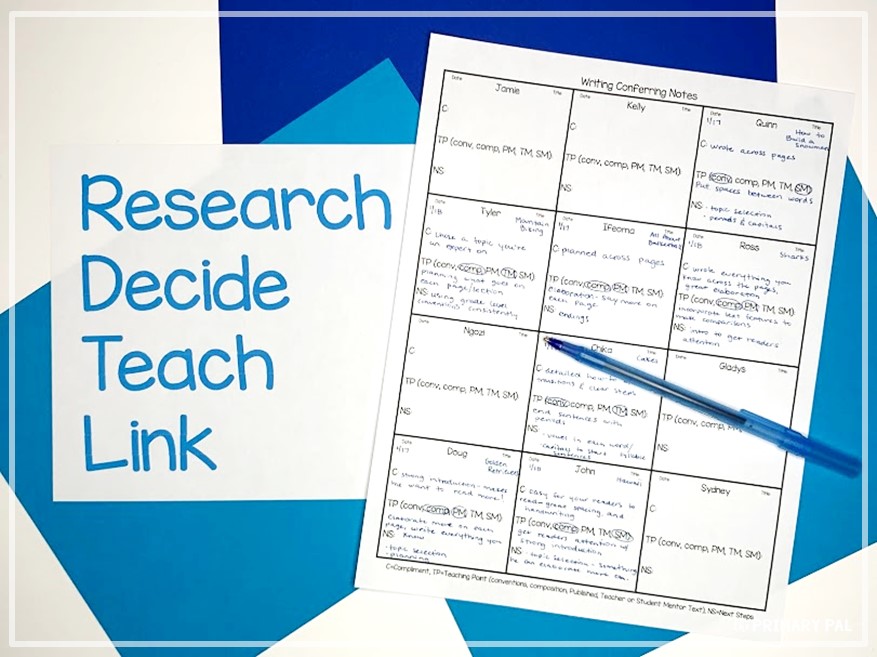
- Research: Talk with the writer about how their work is going by asking open-ended questions that prompt the child to talk about themselves as a writer, not just their writing. This conversation helps determine what to teach and should take 2 minutes or less. You might begin by saying “Talk about what you are working on as a writer today.”
- Decide: Quickly determine what to compliment, what to teach (stick to just one teaching point), and how to teach it. If there are 2 or 3 things you want to teach that child, then you could ask yourself these questions:
-What would help most at this time?
-What would bring quick success?
-What would be a stretch, a risk or a challenge?
-What is not likely to come up in whole class instruction?
Then, deliver your compliment and bridge into your teaching point. This might sound something like, “One thing that I can tell you are working hard on as a writer and that you are doing great with is _________. Now, can I give you a tip to help you become an even better writer?”
- Teach: Incorporate the use of a mentor text (a published book, your own writing, or even student writing) to provide an example of the teaching point. Teach the same type of concepts that you do in mini-lessons; author’s craft, organization, conventions, etc. This portion of the conference is the longest part, around 4 minutes, and most of it should be spent coaching the writer by using active engagement. Transitioning into active engagement might sound something like this, “Let’s try this together and then you can give it a try on your own.” or “Okay, now you try.”
- Link: Wrap up the conference by restating the teaching point. I always leave my writers with a reminder of the teaching point written on a sticky note so they can stick it to a page in their writing folder. This provides an ongoing reference and sets the writer up to connect the teaching point to future work they will do.

Click here to get pre-printed sticky notes to use during your own writing conferences. Even if your conferences do not go as efficiently as you would like, that is okay! Just the act of sitting with each of your writers and talking with them about the work they are doing is significant. It shows them that the work they are doing as writers is valued so much so that we take time to talk with them about it. With practice, you will find your rhythm and you will become more efficient at conducting your writing conferences!

Want to remember this post for later? Save the pin above! For more information on the Writing Workshop be sure to check out the other posts from this series.


